
Father Joseph Illo, pastor of Star of the Sea parish in San Francisco, gave a 17-minute homily on Sunday, October 18.
Today the Gospel is about Church and State. The question is, who rules society? Is it the Church or is it the king?
In America we have this wall of separation between Church and State.
James Madison, in helping write the Bill of Rights, proposed a state not opposed to the Church.
Babylon had over come Israel in 597. Cyrus, the leader of the Persians, in defeating Babylon, sent the Jews home. Cyrus was not a believer, but he served God.
God uses the good and bad to accomplish the supreme good. All of our leaders are under God.
The Pharisees plot in today’s Gospel to trap Jesus. The Herodians also were plotting against Jesus and asked Jesus if we should pay the temple tax. Jesus asks whose image is on the coin and suggests they pay Caesar what they owe him and pay to God what you owe Him.
Thomas More, during Henry VIII’s reign, was imprisoned, said at his trial, “I am the king’s servant and I serve God first.” The government has limited authority.
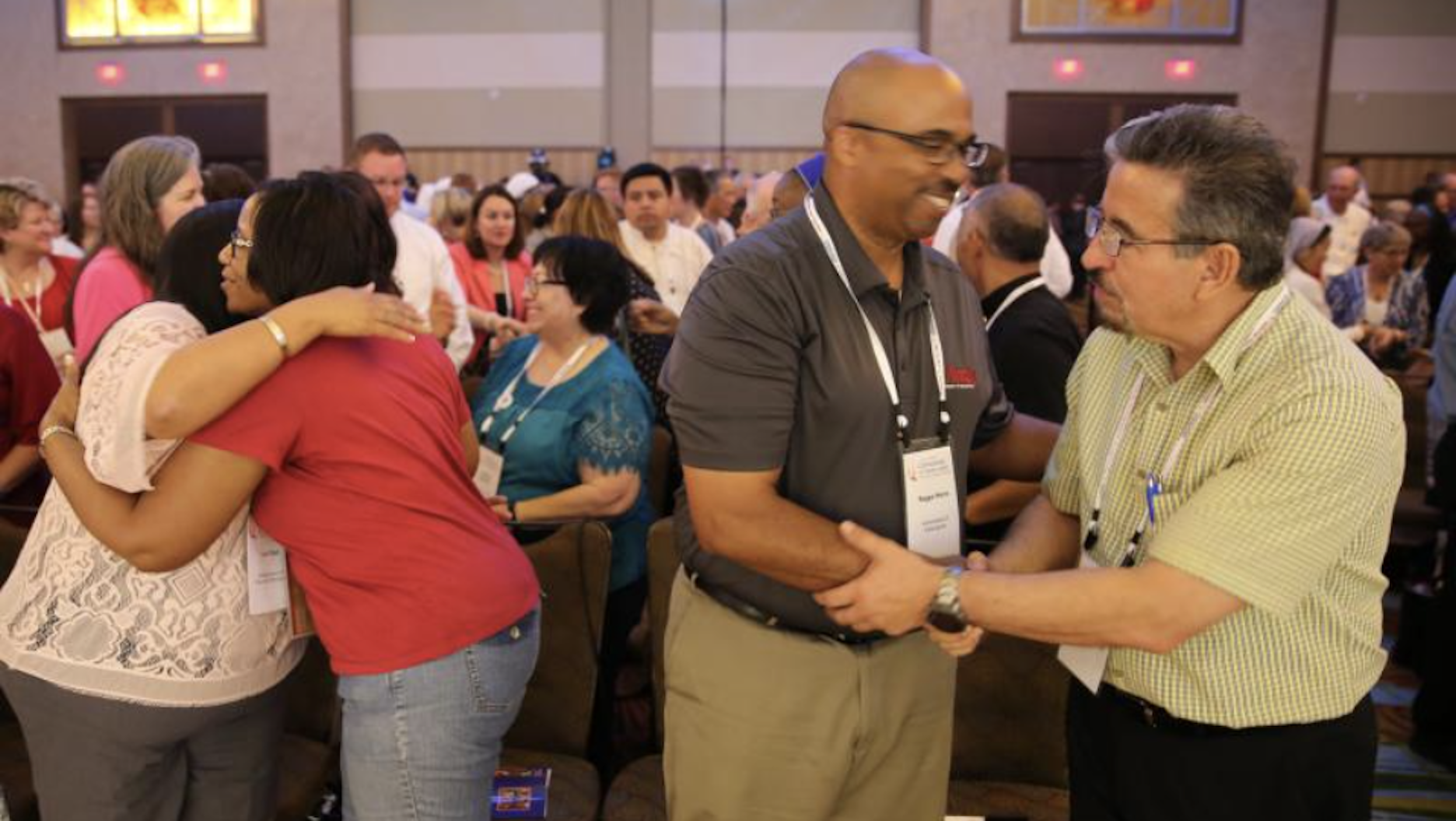
I want to talk about the Sign of Peace at Mass. That ceremony did not exist before 1970. I’ve decided to discontinue the people giving each other the sign of peace. It’s good to greet each other, but not at that time during the Mass. For most of Church history, the priest kissed the altar and gave that sign of peace to the people, but not from the people to each other. We’ll send out a note and there will be a video explaining why we are making this move.


There is a certain specific particular and peculiar liturgical fastidiousness among priests of his ilk. I bet next he’ll deny precious blood from the chalice to the faithful.
His reasoning is flawed. Just because it didn’t exist before 1970 doesn’t mean it shouldn’t be used. It exists in the Missal now. The Mass was changed. Stop trying to go back to what was and live in what is.
Interesting. While often done in a distracting (and prolonged) manner, it is in the Roman Missal (Order of the Mass 128, “Then, if appropriate, the Deacon, or the Priest, adds: “Let us offer each other the sign of peace.”) So, while it may be omitted, it seems the Church’s preference is to have it. I’d like to learn more about what Fr. Illo means by “that ceremony did not exist before 1970.”
The sign or “kiss” of peace existed in the early Church. St. Justin Martyr around 155 A.D. writes about it in Chapters 65-67 of his First Apology. The time or location of the sign of peace in the Liturgy was later changed in the Latin/Western Church. In the early Church and today in the Eastern Catholic Churches, even if only in varied and fragmentary ways, it remains after the Liturgy of Word and before the Eucharistic Prayer. It happens immediately before the Creed, when historically the catechumens and all unbaptized were dismissed from the church. (The deacon then directed that the doors to the church be closed so that only initiated believers remained for the Eucharist. In practice today, all one hears in the deacon chanting “The doors! The doors! In wisdom let us be attentive.”)
In the Divine Liturgy of St. James, the brother of the Lord and first bishop of Jerusalem, thought to be the oldest known Eucharistic Liturgy, the sign/kiss of peace takes place after the Creed. The deacon chants, “Let us love one another with the love from on high!” The people then exchange the kiss of peace with those standing next to them saying, “Christ is among us!” (I know this because I’m reviewing it in order to serve this Divine Liturgy this Sunday in our parish!)
The Eastern Catholic placement of the sign of peace also reflects Jesus’ words, “Before you offer your gift at the altar… reconcile with your brother.” (Matt. 5:23-24)
Might it be possible to instruct those at Mass regarding how to more appropriately and reverently exchange the sign of peace? (Although, admittedly, its Western placement after the Eucharistic prayer, immediately before Holy Communion, is a factor.)
I bow with folded or unfolded hands to the people next to me as similarly done in both the Traditional Latin High Mass and the Ordinary High Mass when the altar boy incenses the people. It is a way of respecting the Holy Spirit in each Christian but avoids any contact if a person might have a cold or other virus and does not know it. To me that is a healthy but respectful way of doing it. Even though handshakes are very western, they are not used in the Traditional Mass. I have shaken hands in Ordinary Masses before with parishioners when offered during times when viruses did not abound, but it really is not a good idea. Handshakes were mainly used in western cultures to make sure the person was disarmed.
A very disruptive rite. You never acted like a baby in church– grabbing a dignified, vested priest during Mass with your grubby hands, mauling him and mauling parishioners– even strangers. The Novus Ordo style Kiss of Peace at Mass was shocking at first. However– I was very ashamed of some older, very annoyed parishioners when this all began. Some were very rude—- no handshakes, just angry scowls and mutttered curses at the new rite, despite being all dressed up. I settled with just a polite handshake.
What parish do you attend where people have grubby hands and maul the priest? I’ll avoid that.
Yet, we should welcome “strangers.” And, you’re right, a simple handshake or even a simple nod of the head suffices.
In the past I have seen a few wildly liberal churches with no respect for God or for the priest. At the Kiss of Peace all pandemonium breaks out, and people go wild, running around grabbing others– and grabbing the priest– their grubby hands all over you like wild animals– with lots of loud back-slapping greetings.Then they can’t settle down well– and forget to kneel after the Agnus Dei, which comes afterwards– and are still talking to their neighbors. Best to greet people nicely after Mass at the Novus Ordo Masses.
The old Latin Mass, and even the ‘interim Mass” wirh vernacular usage, of the mid-1960s, was prayerful and reverent. Very sad, to lose the beautiful, holy, meaningful Introit, Offertory and Communion chants to the Protestant-style, “bombastic” enthusiastic, “four hymns,” though there are very good, traditional Catholic hymns. Catholics are traditionally accustomed to quiet, and prayer, worshipping God– Who is Truly Present– at the Holy Mass. I don’t think the Vatican understands that. “Kiddie-style,” “guitar pop songs”– even worse.
I just submitted a comment about the loss of Mass Propers in the New Mass, as it is now celebrated. The Propers of the Mass, now nearly lost in the Catholic New Mass— are Scriptural antiphons, originally in Latin with Gregorian Chant, and they are integral to the particular Mass of that day. Sometimes, but not always, they are recited in the vernacular, in Masses with no music.
At least we still do have tbe rest of the Mass Propers in the prayers of the priest, the Mass Readings, and Responsorial Psalm, etc. But the Introit, Offertory, and Communion antiphons were lovely. I used to love reading descriptions of the Masses of the early Christians such as St. Justin Martyr (mentioned by Deacon Anderson) when young. I imagined those Masses to be very prayerful, soft, gentle, and kindly amongst the Christians and mysterious wirh Christ truly Present.
That handshake looks kind of gay to me.
Quite the contrary! In western culture the handshake was meant to make sure the other person was disarmed since most men were right-handed and could not draw their swords or weapons if someone was holding that hand. You might call that “gay”, I call it being suspicious for one’s safety. (Laughter.) Which just shows the same thing means different things to different people and different cultures. Lefties have the advantage……sometimes.
Perhaps the man on the left is left-handed and the situation is somewhat awkward.
So, do you think the parishioners in the above photo– are “gay” Catholics, at Star of the Sea church in SF? Are you going to complain to Fr. Illo, that a “gay man” tried to shake your hand at the Kiss of Peace, at his Mass? Did the “gay man” try to date you, after Mass?
Wow. It seems you’re an expert “gay” detector. Does it take one to know one?
What’s your point, man? And, I’m presuming you’re a man. Am I wrong?
I know some guys who even make dinner for their wives and families, change their babies diapers and even help with housework. Is that a sign of something?