

….In the 1990s, when I was a young priest, agencies in the Church were retranslating the Mass into English. Their plans were subversive. They didn’t like words such as “holy,” “spirit,” “merit,” “man,” and even “father.” (Do you remember when they translated Et cum spiritu tuo“ as “And also with you”?) Back then the politically correct translators shunned male pronouns, except when referring to Satan.
Along with several other priests, I started an organization promoting the accurate translation of the Sacred Liturgy using standard English. We enlisted the support of 2000 priests. Many bishops and the Vatican listened to our concerns. We contributed to the cause by offering accurate alternatives to the ideological translations. After many delays, the Vatican released an exemplary translation of the Mass in 2011.
Early in the process, we held a conference of Latinists to translate portions of the Mass for bishops to consider. I wasn’t a translator; I was a paperclip: good at administration, so I organized the gathering. Among the participants was Father Joseph Fessio, SJ, the distinguished head of outfit Ignatius Press. He had studied under three of the greatest theological minds of the 20th century—Henri de Lubac, Hans Urs von Balthasar, and Joseph Ratzinger (Pope Benedict XVI).
I met Father Fessio shortly before the conference as I assembled paperwork for the participants. I was alone. Father Fessio arrived early and immediately offered to assist me with my mundane duties. Time was short, and I needed the help; he didn’t think of himself as too prominent a person to handle a stapler. This wasn’t an isolated act of generosity. Later I visited Ignatius Press and observed how Father Fessio similarly worked with his staff—an intact staff to this day.
Father Fessio designed the Catholic Great Books program at the University of San Francisco and pioneered the most prolific Catholic publishing house in the English-speaking world. But no job was too small for him. He pitched in where he was needed and earned the loyalty of his employees. His recent biography by mentor and historian Father Cornelius Buckley, S.J. (Father Joseph Fessio, S.J., California Blackrobe) is an entertaining (sometimes hilarious) and unsentimental read.
The chapter on Father Fessio’s experiences at Ave Maria University is honest and respectful of those who share his vision. Father Fessio is not a yes-man. Father Fessio has the greatness of a military leader, a customer-relations representative, and that chicken man.
The staff served supper on the evening of my visit to Ignatius Press, after a long and arduous day. Roxanne, a hard-working staff member, fed us. When I marveled at her unassuming generosity, she replied, “I’ve come to serve.” The dedication of Father Fessio’s staff poses this question: Did Father Fessio influence them, or did they influence him?
From Catholic Culture.org by Father Jerry Pokorsky


A Jesuit…in the TRUE sense. God bless him!
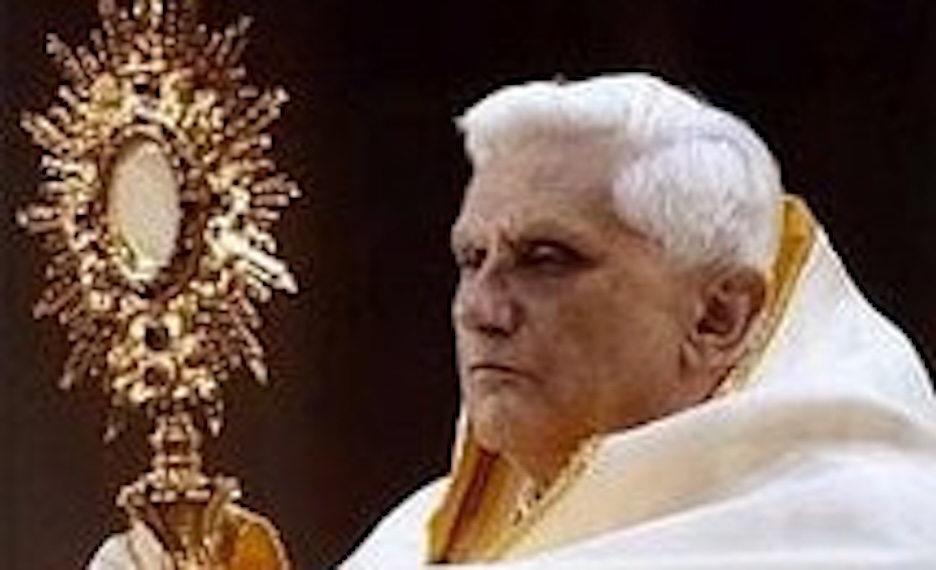
Is that Fr. Fessio, in the photo above, looking at then-Cdl. Ratzinger, with a little girl hanging her arms around his neck? Misleading– and a bit worrisome. Fr. Fessio is an outstanding Jesuit priest of stellar character, intelligence and talents, one of the finest of this age. Please either explain, or get rid of that fraudulent photo– it may be a deliberately distorted, dishonest, altered AI photo. Fr. Fessio was never married with children. Lifelong, he has been an extraordinary, dedicated, stellar Jesuit priest– one of the very finest.
Priests have brothers and sisters and nieces and nephews…And don’t forget friends! The only thing that the photo suggests is that he takes his role as a spiritual father seriously.
As to what happened to the real Father Fessio, no one knows.
Perhaps the little child in his arms is a relative. Don’t be so quick to judge.
Is he an uncle or does he have close friends with children?
I didn’t think anything of the photo (other than it was meant to show him with Cardinal Ratzinger).
For a priest’s biography, he deserves only the very best. Including the best photos. An explanation is needed so the viewer can understand and appreciate the material. Not fair, without that. Not fair for viewers to have to make up their own explanations– especially in this rotten age of Catholic clerics who are criminal pedophiles.
A biography of an outstanding Jesuit priest ought to have good explanations along with photos, of all the situations and people in the priest’s life. Not fair, especially in this rotten age of criminal pedophile priests, to show photos of priests with small children hanging all over them, like they are a “Daddy” to them—- without helpful explanations of the priest’s life, family, friends, and important priestly work and accomplishments. That is very important. Even the famous Fr. Flanagan, who started Boys Town, did not have any photos of little boys hanging all over his neck, affectionately– as if he were their “Daddy”–he was very professional. (Loved the 1938 movie, “Boys Town,” with Soencer Tracy as Fr. Flanagan!) Please specify the relative and their child, then, with a charming quote. It is important– and only fair. All biographies of important people typically have excellent, professional photos of them on the book cover, and in promotional literature.
It looks like I misspelled actor Spencer Tracy’s name in my comment of Oct. 22nd, at 4:57pm. Still would appreciate a cute quip along with the charming photo, of Fr. Fessio holding a small child– (a little girl, possibly a niece?)– while talking to Pope Benedict, that accompanies this news story. Is this a promotional photo to help advertise the new book? Ven. Fr. Flanagan has a Cause for Canonization at the Vatican, which is nice. Hope the canonization process goes well, and hope there was never anything “wrong,” at Boys Town– oh, I am so sorry to say that! Hope all was well in that excellent ministry to help poor, suffering, disadvantaged boys. What can the Church do, for a really excellent ministry, to help poor, suffering victims of clerical child sex abuse? That is so awful.
My mind didn’t go there. It is an innocent photo and you’re making it not so with your over-reacting.
Knock it off, you are insensitive. You totally misunderstand. The photo, with no explanation, as possibly a promotional photo for the new book, was very unusual, and startling to me. Everyone is entitled to their own reactions and concerns.
Ignatius Press an important and amazing Catholic media apostolate.
“Let the little children come unto me.’
J. Christ, Fessio’s boss.