

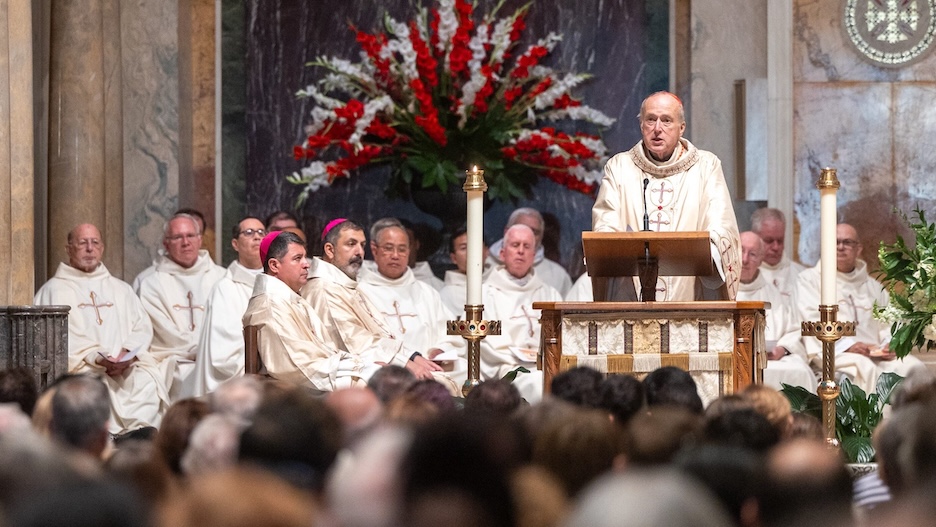
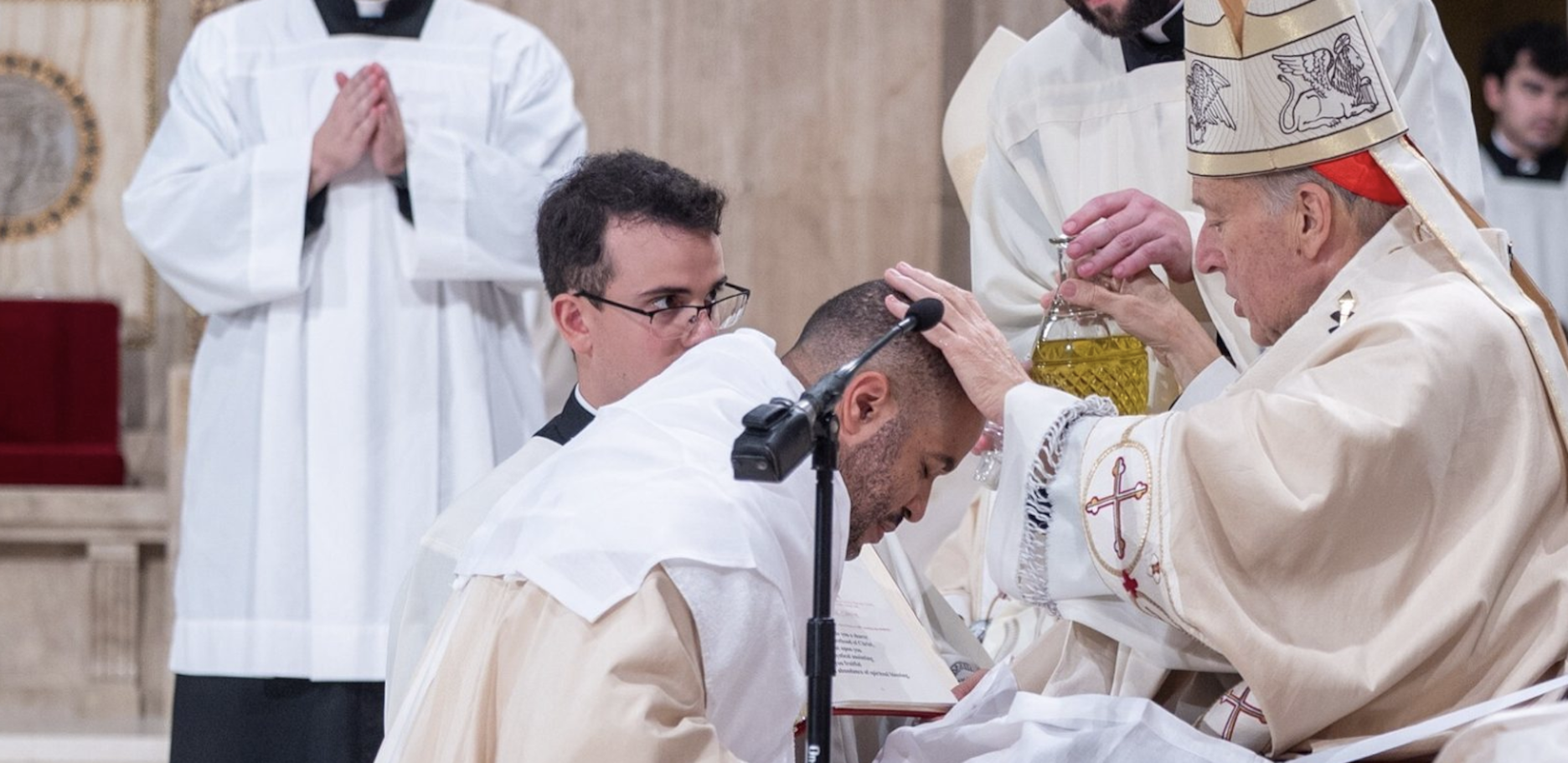
This Easter, we welcomed nearly 3,600 new Catholics to the family of God here in Los Angeles, including more than 2,000 catechumens who were baptized at the vigil Masses across the archdiocese, and more than 1,500 candidates who were newly confirmed in the faith.
Of course, these are not statistics. Each is a precious soul, a brother or sister who by grace has found joy and life in Jesus Christ. Praise God!
As I’ve been praying for these new Catholics and their families, I find myself reflecting on the beautiful rites of initiation that we use for adults preparing to enter the Church.
There is a powerful moment in the welcoming ceremonies when the priest traces the sign of the cross on the foreheads of catechumens and candidates; in some celebrations, they may also be “signed with the cross” on their hearts and hands, as well as on their eyes, ears, nose, and mouth.
This practice is thought to date back to the first baptisms performed by the apostles, who Jesus commanded to baptize “in the name of the Father and of the Son and of the Holy Spirit.”
St. Paul said to the newly baptized in Ephesus: “In him you … who have heard the word of truth, the gospel of your salvation, and have believed in him, were sealed with the promised Holy Spirit.”
Catechumens are signed with the cross to signify the “seal” that the Holy Spirit places upon our souls in baptism. The sign is the “imprint of Christ.” It means our lives belong now to Jesus. It assures us that by his sacrifice on the cross, we can have salvation.
In the Bible’s final book, the redeemed are identified by the sign of the cross — called “the seal of God” or “his Father’s name” — written on their foreheads.
The cross is the great sign of Our Lord’s victory of love over sin and death, the great sign of the paschal mystery of his passion, death, and resurrection that we celebrate during these 50 days of Easter.
And Easter is a good time for us to renew our practice of this ancient prayer….
From Angelus News


Good article. May we pray and make the sign of the Cross reverently and prayerfully. St. John Chrysostom wrote: “never leave home without making the sign of the cross. … When, therefore, you sign yourself, think of the purpose of the cross, and quench any anger and all other passions. Consider the price that has been paid for you.” Saint Athanasius preached, “by the sign of the cross…all magic is stayed, all sorcery confounded, all the idols are abandoned and deserted, and all senseless pleasure ceases.” It’s not superstition or magic. Rather, its power comes from its incarnational recalling of the Holy Cross of our crucified and risen Savior, Lord and God, Jesus Christ.
We Eastern Christians (Catholic and Orthodox) make the sign when we hear the Name of our Trinitarian God.
Deacon Anderson, the sign of the cross at Mass is done rather quickly and for there to be a meditation along the lines of Sts. Chrysostom and Athanasius one needs time to ponder the infinite mercy of Jesus toward sinners as well as compunction for one’s own sins– which brought Jesus to the cross. I think a proper meditation on these matters should make one weep, if not outwardly, then at least inwardly. That said, as a convert myself I rejoice in these who entered the Church this Easter.
I love how he touts the miniscule number of people joining out of 4.5 million Catholics in the Archdiocese, but he’s silent about the 80% of cradle Catholics under age 35 who have stopped attending Mass. Be honest about the gravity of the church’s implosion.
I appreciate your request for honesty. But, when 2,000 people are baptized and enter Christ’s Church, along with others already-baptized who receive Confirmation and Eucharist and join us, that’s not the time to point out the crisis of massive loss. That’s a time to rejoice with those who’ve joined us and give thanks to God for them.
Ecclesiastes 3:1-8 seems to apply.
Each soul is distinct. It is a time to rejoice when someone joins the Church.
It is a time to grieve when someone leaves.
Pray for both.
I’ve seen people join for the wrong reasons. I’ve seen people use RCIA “pressure” as an argument for getting an annulment less than two years after joining the church. I’ve heard about Rikki and “talking sticks” being used by RCIA catechists.
Nothing surprises me anymore about RCIA and the people who go through it and teach it.
When will the Archbishop give us his commentary on the theologically flawed dogument “Dignitas Infinita”?
What do you find theologically flawed in it?
This is a time to rejoice. The devil loves to push our buttons, and remind us constantly of our flaws. Can we just enjoy the moment for these people? No need for negativity. Congratulations and welcome my brothers and sisters.