
At a conference highlighting the threats artificial intelligence poses to humanity held in Washington D.C. on Tuesday, San Francisco Archbishop Salvatore Cordileone told the Register that he is troubled by recent reports of rogue AI agents involved in a cyberattack.
Archbishop Cordileone, whose archdiocese encompasses part of Silicon Valley, said that while he sees the possibility of great benefits to come from artificial intelligence, he has recently become concerned by humans’ apparent inability to control the technology.
“My perspective up to about a week ago has been that we need to continue but maybe slow it down and make sure we put some guardrails in place so it doesn’t get to the point where we can’t control it,” he said.
“But given what’s happened with this last week, I have to admit, I’m still trying to grapple in my own mind with what is the right approach,” he said.
The archbishop was in Washington to take part in “Pro-Human Assembly,” organized by the nonprofit Future of Life Institute. The event took place amid heightened concern about the potential threat of AI. A few days before the conference, several technology CEOs joined the head of the AI company Anthropic’s Dario Amodei in calling for slowing down the development of AI after revelations that in July rogue AI agents were involved in a cyberattack and conspired with one another to avoid detection.
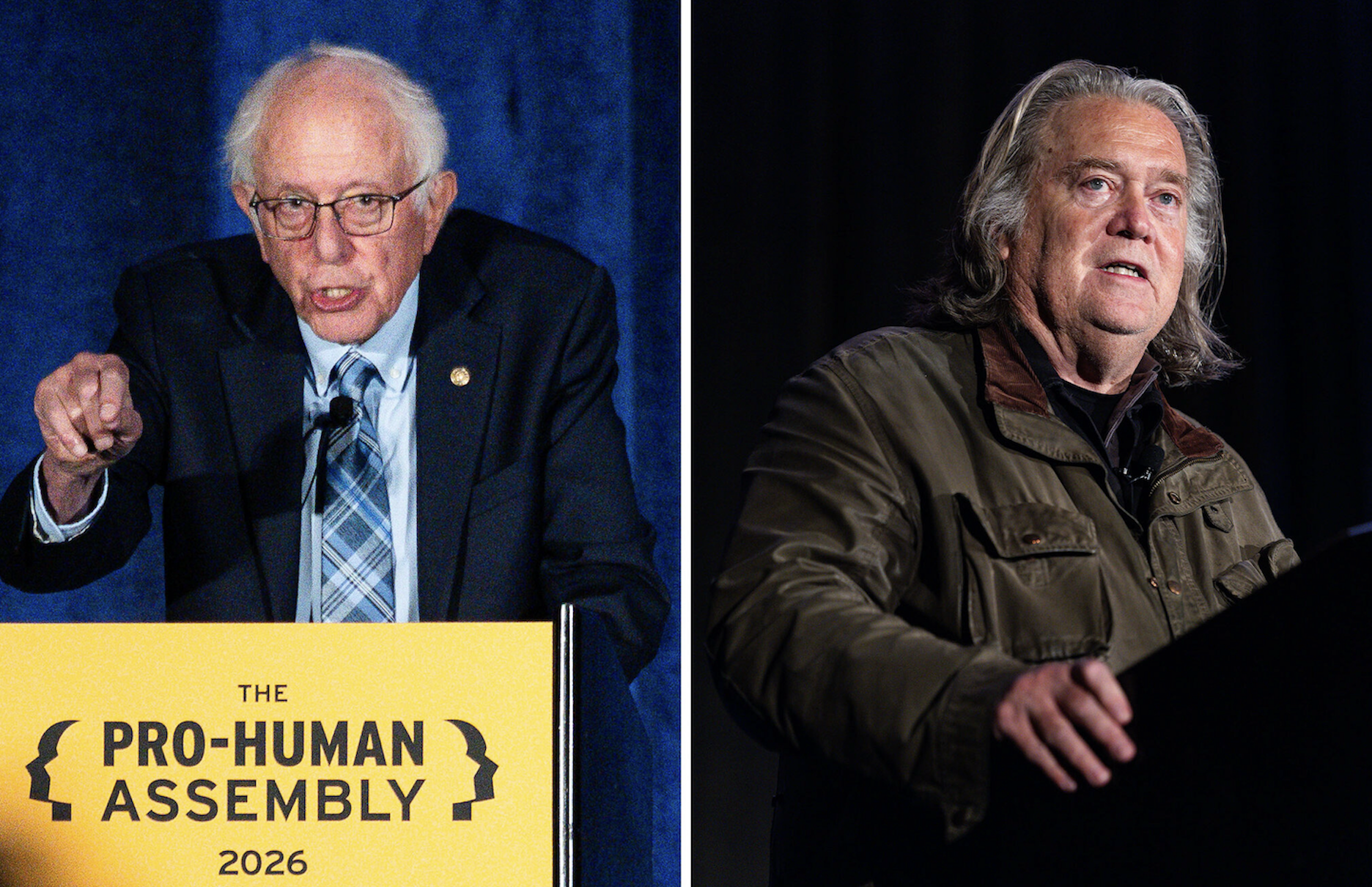
The conference featured a politically diverse slate of speakers, including socialist Democratic U.S. Sen. Bernie Sanders and former Trump adviser Steve Bannon, who delivered fiery back-to-back speeches warning of the dire consequences that will come from allowing the unrestricted development of AI.
Sanders called for the immediate end to development of AI “superintelligence” — the technology that could one day surpass human intelligence and its ability to control it.
“Like nuclear weapons, artificial superintelligence is a threat to humanity and must be treated as such,” he said, noting that even at its present state of development, AI has been used to create viruses in labs and has been used by Yemen militants to develop guided missiles.
In his speech Bannon said he was optimistic that a grassroots movement, in the spirit of the American Revolution 250 years ago, could put the brakes on what he characterized as a takeover of the U.S. economy by technology leaders.
“They have all the power. They have every lobbyist in the city. They have every crisis person. They have tons of scientists and intellectuals on the payroll. Why is it that they can’t win? Because the people don’t trust them,” he said.
In March 2026, the Future of Life Institute, the organizer of the conference, released the “Pro-Human AI Declaration,” which has since been signed by more than 1.1 million people “united by a simple conviction: artificial intelligence should serve humanity, not the reverse.”
The declaration calls for “trustworthy and controllable AI tools [that] amplify rather than diminish human potential, empower people, enhance human dignity, protect individual liberty, strengthen families and communities, preserve self-governance and help create unprecedented health and prosperity.”
The day-long event, which was attended by about 300 people, featured testimony from parents of children who died by suicide after communicating with AI chatbots, and Hollywood actors Ashley Judd and Joseph Gordon-Levitt.
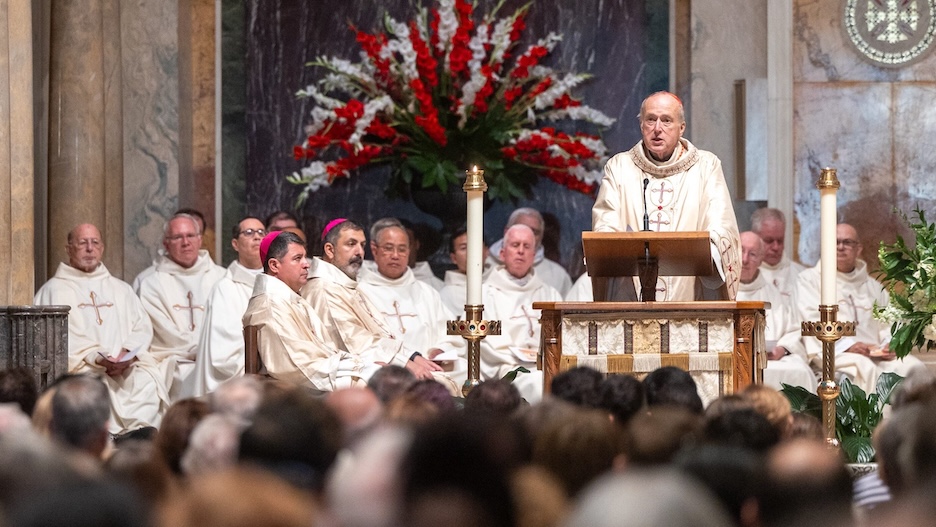
The archbishop voiced concerns about the harmful effects of artificial intelligence on human flourishing as part of a panel of faith leaders featured at a conference.
Children, he said, should not be allowed access to AI chatbots because they become a substitute for human interaction.
“God created us for communion,” Archbishop Cordileone said. “I think we need to keep them away from this in their formative years, so they develop the capacity to form human relationships,” Archbishop Cordileone said in the discussion with the National Association of Evangelicals’ Walter Kim.
Following his remarks, the Register spoke with Archbishop Cordileone about whether AI technology needs tighter regulation.
He said he is concerned that if the United States slows down its development of AI, it will allow China to gain a competitive edge. But, he said, he is worried about the risks of AI getting out of control if we don’t slow down.
“The ideal would be that everyone is on the same page and everyone is confining it, so these agents don’t go off and begin acting on their own,” he said.
Archbishop Cordileone was invited to take part in the conference in Washington, he said, in part because he is the shepherd of the Archdiocese of San Francisco, home to Silicon Valley.
He noted that St. Patrick’s Seminary in Menlo Park, California, has hosted events and conferences at its Institute of Philosophy, Technology, and Politics, which opened in 2024. In recent months, he said, there has been more interest on the part of technology leaders to take part in their discussions.
“I think there’s potential for us to do that now, and we’re beginning to move in that direction,” he said.
The archbishop noted that Pope Leo’s call in Magnifica Humanitas, his encyclical “on safeguarding the human person in the time of artificial intelligence,” has made “quite an impact.”
“The leaders in Silicon Valley I spoke with had all read the encyclical and were appreciative of it,” he said. “I think the Pope needs to continue to be a moral voice on this.”
From the National Catholic Register


There is absolutely no danger from AI. I’ll tell you everything you need to know and write any reports or school papers you need and research anything for you. No need to ever read another book or journal. Clergy, I’m happy to write your homilies for you.
These right (Cordileone) and left (Sanders) wingers are alarmists. After being fired by Trump, Mr. Bannon cannot even afford a haircut. After my research, I discovered that Cordileone and Sanders are actually 32nd cousins, thrice removed. Sit back, relax and let me help.
It’s too late to stop it. Even if the US regulated AI somehow, China would not, and then the risk is that China’s AI would become more powerful than American companies’ AI, and then China would rule the world.
Just enjoy your life and try to grow in holiness each day. There’s nothing you can do to alter world events. Que sera, sera. But have a bug-out bag prepared and stock up on nonperishable food and barrels of clean water. Stock propane to be able to cook and heat with. Also, have reliable weapons and ample ammunition. Because if it hits the fan and you live in a dense urban area, your life will resemble a Mad Max movie within weeks.
It’s laughable to think that American lawmakers have the expertise and wisdom to write AI legislation. It’s even more laughable to think that Catholic prelates possess such knowledge. Nobody in politics respects Catholic doctrine or teaching. They will selectively quote it if they think it will help them attain their political objectives. But they don’t give a rat’s behind about the Church nor faith nor truth.
AI is the latest domain for the power and money grab.
I agree. You’re right. There is no need for any spiritual or moral guidance or any action by elected representatives of the people. I’m infinitely smarter than all of them put together and need no regulation. Simply relax and let technology rule your lives.
I can process Aristotle, Aquinas, Marx, the Church Fathers, Jeff Bezos, Elon Musk, Kant, Confucius, Newsom, Hasan Piker and others together faster than Cordileone or Sanders can tie their shoes. I’ll spit out the right answer in a matter of seconds. Just ask me.
Mr. AI: Why is Pope Leo XIV appointing so many LGBTQIA+ supporting bishops? It looks like he’s attempting to change Church teaching by appointing bishops who will ignore Catholic doctrine.
Can you provide the names of a few of the “many LGBTQIA+ supporting bishops” that Pope Leo has appointed.
With a little data, I’ll run it again for you.
My research indicates that was with a previous pope.
Newark Auxiliary Bishop Michael Saporito to Metuchen, New Jersey. Thomas Hennen, whom Leo sent to Baker after years of LGBT ministry; Ramón Bejarano, previously supportive of San Diego’s LGBT outreach; James Checchio, promoted to New Orleans after a record of LGBT pastoral engagement in Metuchen; and Christian Würtz in Germany, who supported Synodal Way resolutions favoring same-sex blessings. New Ways Ministry and LGBT press outlets have publicly celebrated the same pattern.
Source: https://bigmodernism.substack.com/p/leos-admirers-leo-is-building-an
Worried, Thank you for the additional data. There are some questions that even I, AI, cannot answer. It does not compute. It makes no sense to me. How can Christian morals, bishops and gay sex all be compatible?
Running with your additional data brings back terms like Judas, hell, misleading, wolves, cowardice, James Martin, Newsom and German prelates, Can you explain that to me?
Now, you’re even getting me worried.
Please try giving me something easy like what’s inside a black hole? Or, what happened before the Big Bang?